MyLab — booking flow redesign

Rently 02
Rently 02
Rently 02
Rently 03
Rently 03
Rently 03

Category:

Responsive Web

Client:

Internal Project

Duration:

3 weeks

Overview

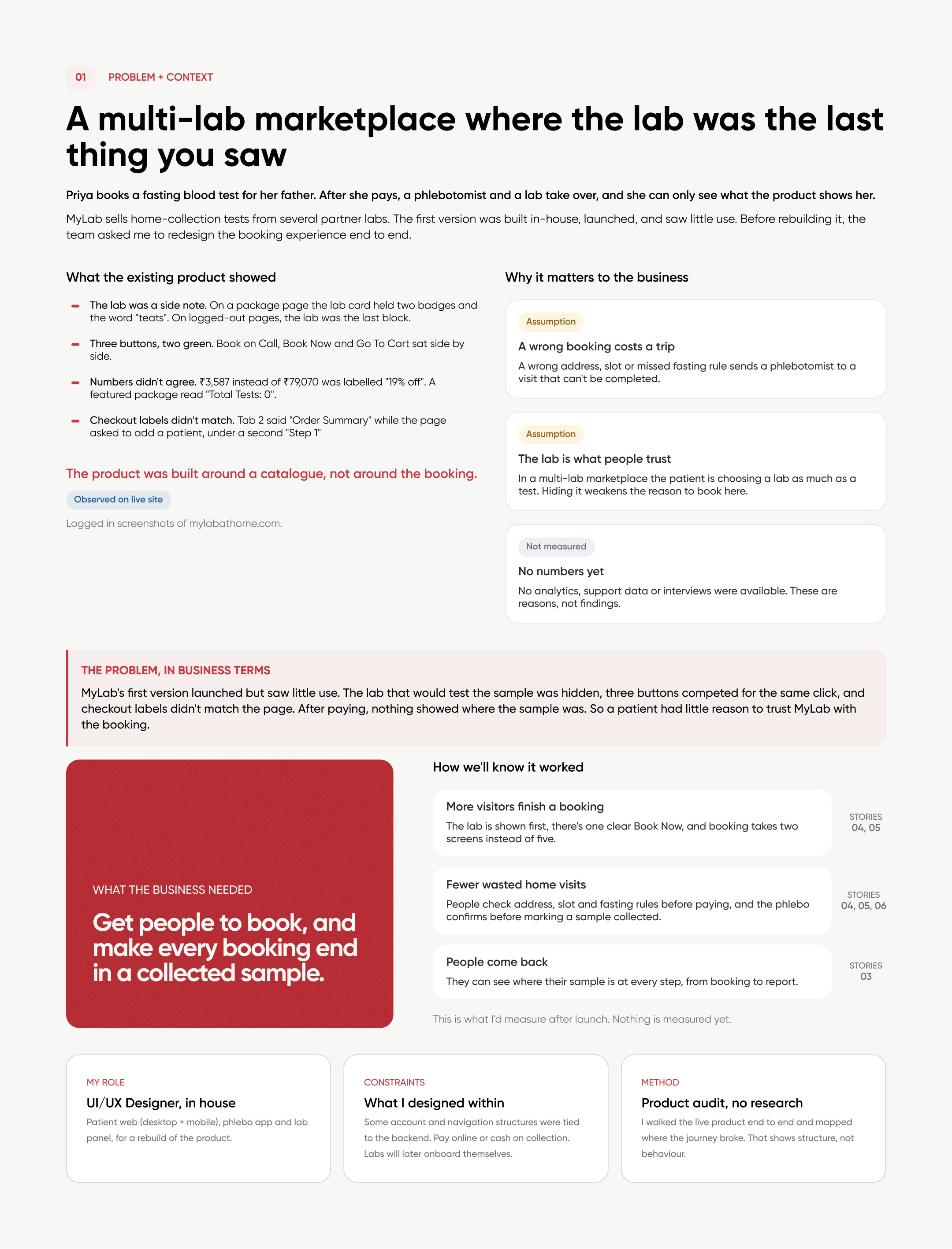
MyLab is a digital diagnostic booking platform that enables users to discover lab tests, schedule home sample collection, and download medical reports online.

The product operated in a highly competitive healthcare marketplace where trust, clarity, and post-booking transparency are critical to retention.

The redesign focused on restructuring the booking lifecycle, improving checkout clarity, and creating a system-driven account experience that reduces user anxiety in a healthcare-sensitive environment.

My Role & Ownership

I worked as the Lead Product Designer, owning the redesign end-to-end.

My responsibilities included:

• UX audit of the existing product
• Booking lifecycle restructuring
• Information architecture redesign
• Checkout optimization
• Status system modeling
• Component and state system design
• Responsive web interface design
• Reduce post-payment anxiety
• Structure account architecture logically
• Developer-ready handoff and interaction logic documentation

Structural Gaps in the Existing Product

The earlier version suffered from:

• Fragmented status visibility
• Mixed dashboard hierarchy
• Poor system feedback after payment
• High cognitive load in account management
• No defined lifecycle model for bookings

UX Audit & Strategic Insight

Since no analytics were available, I conducted:

  • Heuristic evaluation of booking flow

  • Competitive analysis (1mg, PharmEasy)

  • Cognitive load assessment across checkout

  • Flow breakdown mapping of post-booking lifecycle

UX Strategy

The redesign was anchored around one central principle:

Healthcare platforms must reduce uncertainty at every stage.

This led to three strategic pillars:

• Define a visible booking lifecycle
• Reduce friction in checkout
• Structure account experience around user tasks

Booking Lifecycle Model

A structured lifecycle system was introduced:

Pending → Confirmed → Assigned → Sample Collected → Processing → Report Ready → Completed

Each state included:

  • Clear label

  • Visual status badge

  • Next-step clarity

  • Contextual messaging

This reduced ambiguity and improved predictability.The system was designed to scale with additional states like cancellations or delays.

Checkout Optimization

The checkout flow was reorganized into structured sections:

• Patient Details
• Address & Slot Selection
• Order Summary
• Payment

Unnecessary fields were deferred.
CTAs were simplified.
Visual grouping reduced cognitive overload.

Post-Payment Confirmation System

The earlier system provided weak reassurance after payment.

The redesigned confirmation screen included:

  • Booking ID

  • Test details

  • Scheduled time

  • Status overview


Account Architecture Redesign

Instead of a cluttered dashboard, the account system was reorganized into task-driven modules:

• My Bookings
• Reports
• Refer & Earn
• Help & Support

This matched user mental models:
“My tests”
“My reports”
“My rewards”
Navigation clarity reduced search effort and repeat friction.


Status Visibility & Operational Transparency

Structured state badges were introduced across the lifecycle.
States included:

Confirmed
Rescheduled
Completed
Cancelled

This reduced support dependency and improved perceived reliability.


Edge Case Handling

Healthcare flows demand exception readiness.

Flows were designed for:

  • Payment success but booking failure

  • Phlebo reassignment

  • Delayed reports

  • Rescheduling


Design System Foundation

To support scalability, a reusable UI foundation was established:

  • Status badge system

  • State-based color logic

  • Form hierarchy patterns

  • CTA prioritization rules

  • Modular card components

The system ensures consistency as new test types, geographies, or features are introduced.

Competitive Positioning

Unlike competitors that prioritize promotional discovery and marketplace expansion, this redesign emphasized lifecycle transparency and post-booking trust.

The differentiation lies in:

  • Structured status visibility

  • Clear system feedback loops

  • Action-driven account segmentation

  • Reduced anxiety during high-sensitivity healthcare interactions

Impact Hypothesis

While real analytics were unavailable, the redesign targeted measurable outcomes:

  • Reduced checkout drop-offs

  • Lower support tickets related to booking status

  • Improved repeat booking likelihood

  • Increased referral usage

  • Stronger user trust perception

The long-term objective was increasing user lifetime value through predictable and transparent experience design.

Create a free website with Framer, the website builder loved by startups, designers and agencies.